Cavallino Market by Cyrille Jaquinot
I, Cyrille | Ferrari History Books | Ferrari Coffee Table Books | Ferrari Brokerage | Ferrari Archives | F.A.Q.
Ferrari History Books by Cyrille Jaquinot
Instagram | Linkedin | Contact us by mail
Ferrari 212
| 212 Inter (1951-1953)  |
Ferrari History Books
Ferrari 212 Inter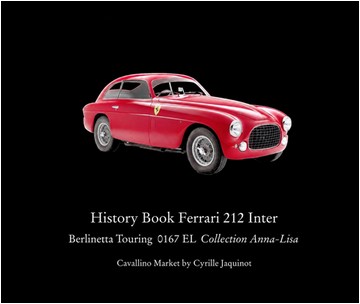 Berlinetta Touring 0167 EL |
| The Gioacchino Colombo V12 was bored out to provide a bigger displacement. The chassis was inspired by that of the 166 MM, with modifications aimed at transmitting the higher power output to the road. The later versions saw the introduction of a tubular chassis known as the ‘Tuboscocca’, which increased structural rigidity. Apart from Touring and Vignale (stylistically, the most successful at interpreting this chassis), both the Turin-based Rocco Motto coachworks and Fontana from Padua tried their hand at bodying this model. The 212 series of cars were built between late 1950 and 1953, in Inter and Export model configuration. The former was the road model, and the latter ostensibly the competition model. The Inter road version was the most prolific of the early series of production cars manufactured by Ferrari, with the greatest variety of body styles, with berlinetta, cabriolet and coupé variants. The styles even varied significantly within the examples produced by a single coachbuilder, notably those from the Vignale design studio. This series of cars carried coachwork by Ghia, Ghia Aigle, Pininfarina, Stabilimenti Farina, Touring, Vignale, and even the British firm Abbott produced a rather ungainly cabriolet, that has long since been re-bodied in the style of a Touring barchetta. The 212 models featured the traditional 60° V12 engine based on the original Colombo design, but now with a bore and stroke of 68 mm x 58.8 mm, to give a cubic capacity of 2562 CC. As with the preceding models, the competition designated cars were normally fitted with triple twin choke carburettors, although there are exceptions, and the road versions with a single twin choke unit, with the three carburettor arrangement available as an option, providing a power output ranging between 130 and 150 bhp. The chassis construction principles and suspension layout were virtually identical to the preceding 166 and 195 Inter models. © Ferrari SPA |
© Cavallino Market by Cyrille Jaquinot
 Cavallino Market by Cyrille JAQUINOT